
 Oleg Itsekson
«OPEN TV CHANNEL»
Shavuot is perhaps the most mysterious of Jewish holidays. His symbolism is full of inner meaning, and at the same time full of ambiguities. Answers to the questions of the holiday lead us from ancient times straight to the present.
Shavuot completes a cycle of three pilgrimage holidays, during which Jews once traveled from all over the country to Jerusalem to offer traditional sacrifices. Among its attributes are milk dishes, roses and fragrant herbs, offerings from the sprouts of the new crop: two loaves of freshly ground wheat, the first fruits. And also - a sleepless night, which is spent reading the original sources, according to the custom of the Kabbalists, the authors of the Book of Zohar.
The date of this holiday is indicated not according to the calendar, but according to the personal count of the omer. This account begins on Pesach and lasts fifty days. Thus, Shavuot symbolizes the end of a certain process. Which one exactly?
On Passover, the Jews came out of Egyptian slavery. This means not just escaping to the Sinai desert, but inner liberation, victory over foreign values and a return to one's moral heritage, to the warmth of fraternal relations. In Egypt, we were enslaved by mutual hostility, which reached the point of hatred. This is the "power of Pharaoh" - a state of discord and internal strife.
The first move towards unification allowed the exiles to throw off these bonds, to remove what separated them. He overthrew the Pharaoh in himself, and they ended his external domination. But this was not the end yet - they had a new test ahead of them. It is said: "And they came to the Sinai desert, and Israel camped there opposite the mountain." At this stage, the Torah already considers the Jews as a single whole, as an indivisible community, or as "one person with one heart." And this unity is opposed by a mountain of hatred (Heb. son) is the antithesis of striving for love and devotion.
Here, our ancestors were faced with a decisive choice: either hatred will turn into a "common grave" for them, suffocate them in its arms, or they will rise above selfishness and become guarantors of each other, or in other words, a strong family that knows how to correctly resolve internal conflicts, not depriving anyone of its care. And then they said: "Let's do it and listen."
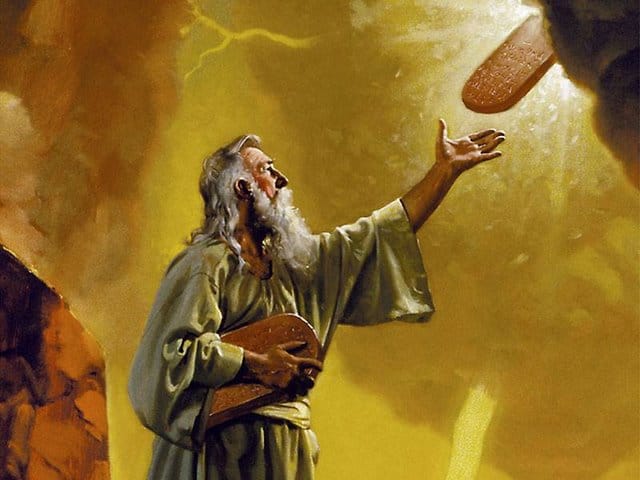
It is precisely this fateful milestone in Jewish history that the holiday of Shavuot represents for us. Its essence is the lifting up of oneself, Moshe's ascent to Mount Sinai and the subsequent giving of the Torah. But not just historical chronicles, but instructions, methods, which have been the basis of our association since then. It was printed not in scrolls of parchment, but in hearts, and made us the real people of Israel.
This people, the only one in the world, is not gathered on ethnic grounds. He is the bearer of ideas, the spiritual vanguard of humanity. At Mount Sinai, we declared our unique mission - to bring people "light", in other words, to show an example of how to rise above all selfish passions for unity and mutual understanding.
The power of this impulse is so great that it started three world religions, led us through unimaginable vicissitudes of history and rooted in the world values that it did not know about before. Even today, after two thousand years of exile, when we have forgotten our origins, the story of the giving of the Torah resonates with us as something distant, vague, but very important.
One of the greatest kabbalists of the Jewish people, Rabbi Akiva, said that the entire Torah boils down to one main principle: "Love your neighbor as yourself". It does not just proclaim an ideal, it leads to it. Her commandments are, first of all, internal steps towards good relationships between us, no matter what lifestyle we lead and no matter where fate throws us. This is what the Torah was given for, this is what it was intended for.
And it is not by chance that we annually celebrate that special day at Mount Sinai. After all, "Torah", as a means of uniting all parts of the people into one whole, is always "given" to us, made available for our use.
And from this arises the main question that Shavuot poses to us: are we ready to receive the "Torah"? Precisely as a method of building true relationships, a true relationship over all conflicts. Today, now. After everything experienced by generations of our ancestors, after spiritual oblivion and the long-awaited revival of the country. Are we ready, as in ancient times, to become guarantors for each other?
Unfortunately, the answer is obvious. If we fulfill the commandment about love between us, it is exactly the opposite. If we are an example, then in completely different things, albeit partly useful, but not allowing to resolve conflicts and contradictions, because of which two World Wars have already swept across the planet, and the Third is brewing before our eyes.
We are still far from the warmth of a friendly family, fragrant as fragrant herbs, from holy love, white as mother's milk. And that's why the attributes of Shavuot seem childish and poor compared to such "heavyweights" as Sukkot and Pesach. We have not yet explored its depth.
But still, time passes, the world changes, and we again begin to experience its pressure on ourselves. He did not forget about us. He does not know what was given to us that day, but he needs it inexplicably. After all, we have in our hands a tool that allows us to restore harmony between people, sectors, countries, peoples. The tool is fail-safe because it is based on goodwill and full mutual trust. And therefore, today Shavuot reminds us, shouts to us: "What you have been given, you must finally receive and pass on to others!" Shall we do it?
