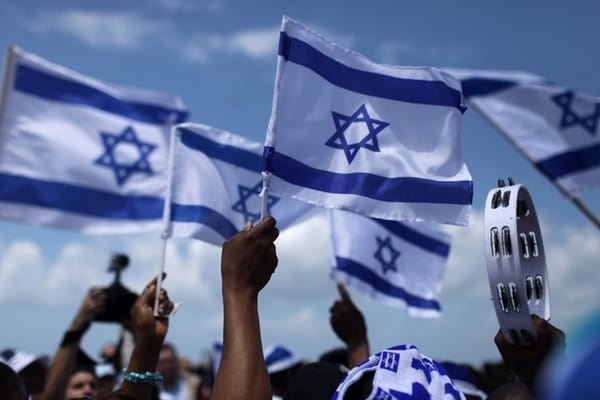
The Khmelnytskyi Charitable Foundation "Hesed Besht" expresses its solidarity with the people of Israel, who on Iyar 4 (this year falls on April 28) celebrate the Day of Remembrance for those who died in wars and terrorist attacks.
Just a few hours after the birth of the State of Israel in 1948, seven Arab countries crossed its borders without a declaration of war and began military operations. However, even before the official start of the war, four Jewish religious settlements near Jerusalem were hit by bloody Arab raids. There were numerous casualties, and part of the population was taken prisoner. Israel lives permanently at war, and terrorist attacks are still commonplace, no matter how scary it sounds.
Yom HaZikaron (the Hebrew word for Remembrance Day) is an Israeli national day of mourning. Every year, the country accurately counts the number of Jews who died in the Arab-Israeli conflict and terrorist attacks since 1860. On the eve at 8 p.m. and on Iyar 4 at 11 a.m., a funeral siren traditionally sounds in Israel. For two minutes, everything freezes: traffic stops, people stop, and their heads bow in mourning. Mourning rallies, torchlight processions, and memorial ceremonies are held at military cemeteries and at memorial sites where battles were fought.
And on Iyar 5 (April 29), Jews around the world will celebrate Israel's Independence Day. This is the country's main national holiday. How was it started?
World War II was over, and the world was celebrating its victory over Nazism. Barely a third of Europe's 9 million-strong Jewish community survived the war. But the trials for the Jews did not end there. After the war, the British imposed even greater restrictions on Jewish repatriation to Palestine. The response was the creation of the "Jewish Resistance Movement", which aimed to fight the British authorities for free entry into the country. Despite the naval blockade and border patrols established by the British, from 1944 to 1948, about 85,000 people were smuggled to Palestine by secret (sometimes very dangerous) routes.
The situation in the country was extremely unstable, practically a crisis, and the British government was forced to refer the solution to the Palestinian problem to the United Nations. It decided by a majority vote (33 to 13) to partition Palestine into two states.
On May 14, 1948, David Ben-Gurion read the Declaration of Independence at a meeting in the Tel Aviv Museum. The new state was called Medinat Yisrael - the State of Israel. The Jews were jubilant, the Arabs protested and began military action. So the land of their ancestors, the territory designated by the UN for the creation of a Jewish state, had to be defended with weapons in their hands. In that war, which lasted 15 months, more than six thousand people died. They gave their lives so that the State of Israel would not be a dream, but a reality.
In Israel, Independence Day (in Hebrew, Yom Ha-Atzmaut) is celebrated with ceremonial receptions, sometimes with military parades.