
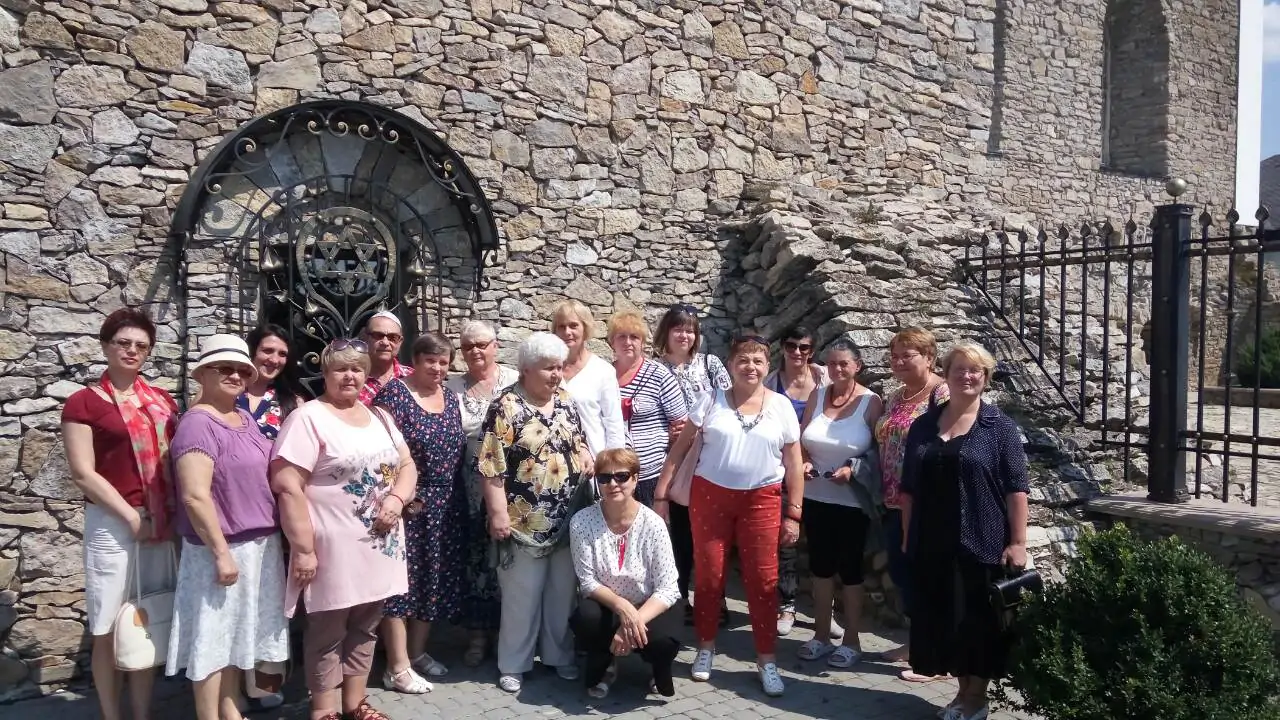
Participants of the project “Lessons of Historical Truth” visited the former Jewish town of Sataniv. Now it is famous for its healing waters, and once it was known for Jewish sages and righteous men. The Sataniv synagogue is over 500 years old, it was built in 1532. However, folk legends say that it is not man-made and existed before the beginning of the world. People began to dig a high hill and came across something solid, dug deeper - and this is the synagogue. There is another legend: that the synagogue was moved from Jerusalem itself by divine power.
The Satanov Cold Synagogue (so it was called, because unlike the other seven synagogues of the town, it was never heated) was part of the fortification and withstood many Tatar and Turkish raids. Its walls are two meters thick. The attic of the building played the role of a battle tier, and cannon loopholes have still been preserved in it. There are several underground passages through which Satanov was supplied with provisions during sieges. A Jewish school and library were constantly operating in the temple (in 1776, the book collection numbered 754 books and was the largest in Podillia).
During the Soviet years, the synagogue served as a gunpowder warehouse and granary, and was practically destroyed. And during the war, a terrible tragedy occurred here: in May 1942, the Nazis bricked up 286 Jews alive...
The synagogue was restored in 2014 thanks to the famous patron Arthur Friedman. And although its appearance is quite modern, some artifacts have been preserved: these are frescoes on the slopes of the windows and the unique Aron-kodesh - a place for storing the Torah. The Satanov Synagogue is a pearl of the historical monuments of Satanov, one of the rarest Jewish buildings in Eastern Europe. Tour guide Oleksandr Nishchenko told us about all this.
Since our trip was on a Sunday, the project participants listened to the Torah section “Balak”, which was read that Sunday in all synagogues around the world. And then we visited an ancient Jewish cemetery on a hill behind the Shmaivka River. Traditionally, all Jewish cemeteries were located in the highest place behind a river or stream, which symbolizes the separation of the dead from the living. In each shtetl there were two main spiritual centers: a synagogue and a cemetery, which served as a concentration and artistic and plastic manifestation of the national spirit. Cemeteries are accessible museums of national sculptural creativity.
The Sataniv Necropolis is one of the oldest. It is the second oldest burial site in Europe after the Czech one. The oldest matzeva dates back to 1576. 14 tzaddikim and rabbis, the daughter of a rabbi, Sarah, and a righteous woman who healed people are buried in this cemetery.
Conventionally, the necropolis is divided into two parts: the old cemetery, which has 500 burials from the 16th-19th centuries, and the new one, where there are 300 burials from the late 19th - early 20th centuries. The cemetery has preserved a huge number of matzevs, and each of them is an extremely valuable monument, a very significant page of Jewish material culture. It is worth recalling here that Judaism prohibits the depiction of people, so a kind of portrait of the deceased (his profession, origin, habits, character) were encrypted with various symbols. A hundred years ago, every Jew could freely "read" this stone code. And now we are re-learning the language of symbols. If we take it literally, we are fulfilling the biblical saying "time to gather stones", even if these are stones of steles scattered across various necropolises...


