
"Peace will not disappear because of excess
people, but there is an abundance of non-humans."
(Jewish proverb)
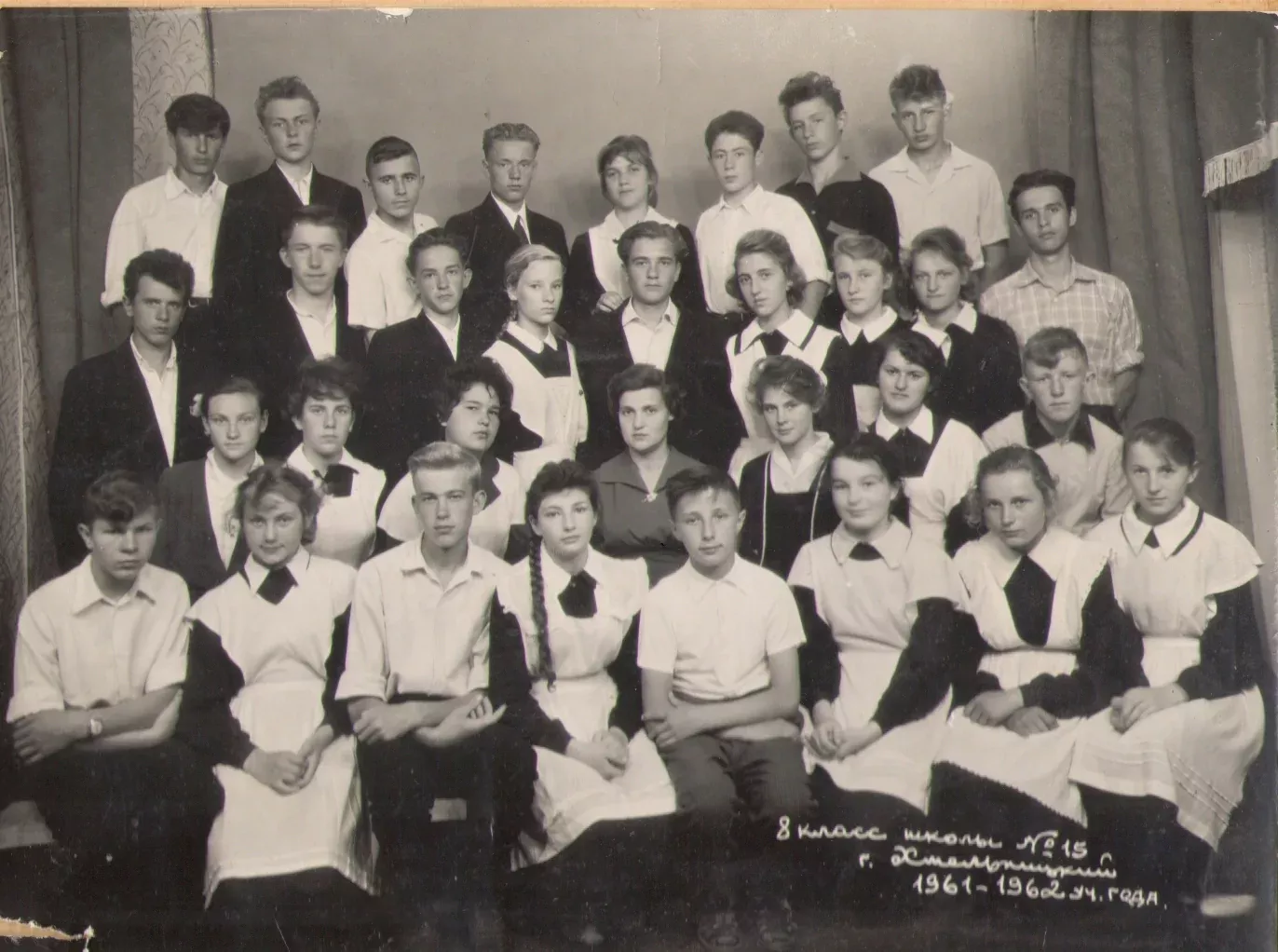
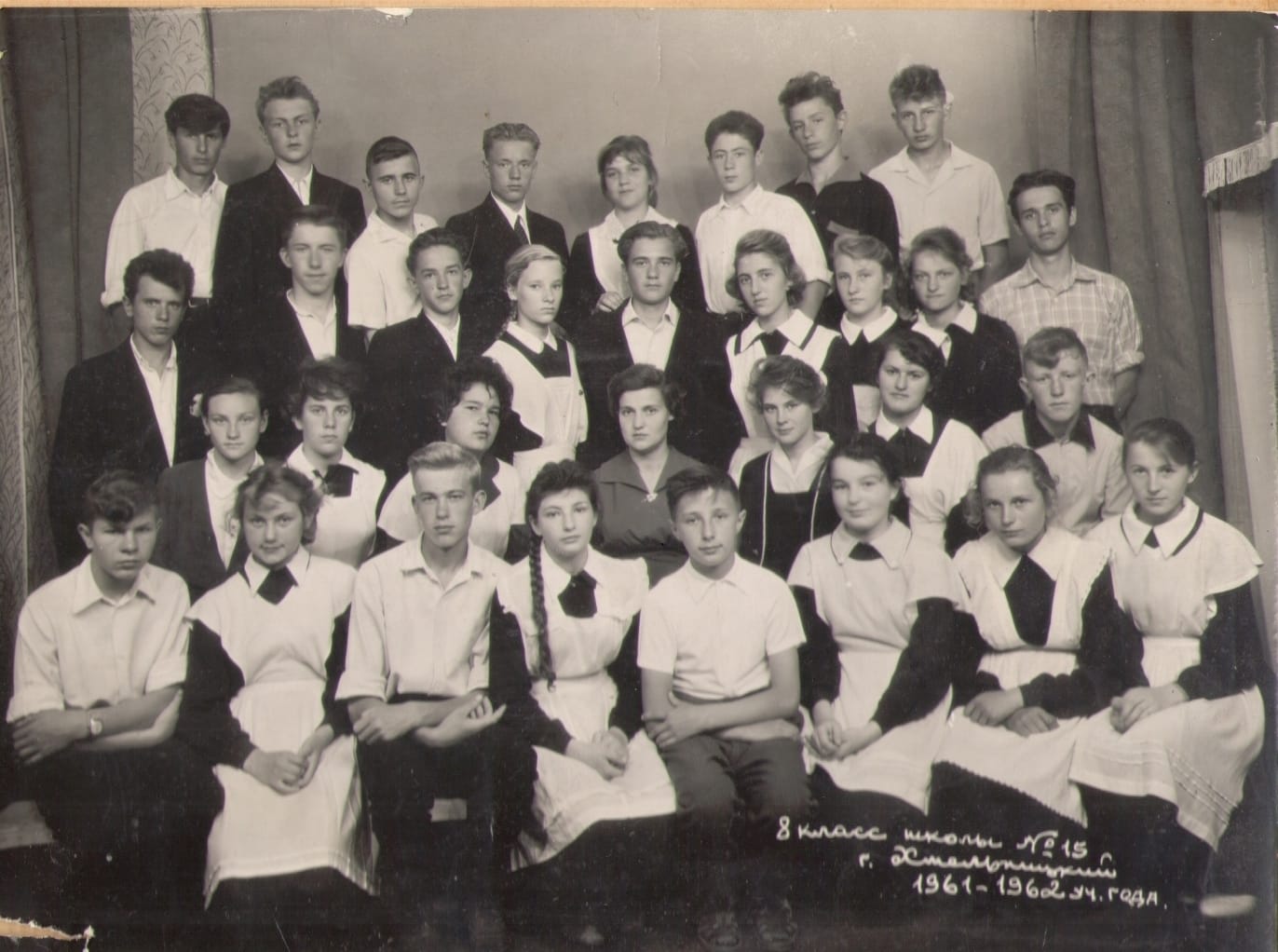 In the school photo, my classmate Oleg Kachurovsky (second from the left in the second row from the top) is no different from us, only he is taller and looks much more serious. In the eighth grade, Oleg already had the highest ranks in chess and athletics. While studying in Kyiv and later, returning to Khmelnytskyi, he constantly took first place at the city chess championships. Oleg's half-sister Lyudmila still works as a doctor, although she is 78 years old. Oleg and Lyudmila are the grandchildren of Klimenty Vasilyevich Kachurovsky, the children of his youngest daughter Tatiana. From Oleg, I learned a lot of interesting things about his grandfather. Priest Sergey Prychyshyn, who was personally acquainted with Tatyana Klymentyevna Kachurovskaya, told me about some cases from his life.
Cathedral of the Nativity of the Virgin.
After graduating from the Odessa seminary, Klimenty served as a protodeacon in the Cathedral of the Nativity of the Virgin and lived with his family, his wife Appolinaria Kazimirovna and three children, in Proskurovo. Appolinaria and Klimenty loved each other very much. She, the daughter of a rich Polish nobleman, married Kachurovsky against her parents' wishes and moved from Krakow to live with him in Ukraine. Appolinaria's parents, devout Catholics, never forgave her unequal marriage and conversion to Orthodoxy. Since then, they have never seen their daughter again. And here, in Proskurovo, she found her happiness. Three children were born - daughters Sofya and Tatiana, son Dmitry. Their cozy one-story brick house stood not far from the Cathedral (now the house is gone, it was swallowed up by the market). The maid Shtefka helped run the household and raise the children. Here there was everything necessary for a calm, balanced life - the Yuzhny Bug river, a bathhouse on the river bank, and an old bazaar nearby. But their life was subordinated to the church. Services, ringing of bells, parishioners, books filled all free time. The Cathedral housed one of the most famous libraries of old church books, among which the most valuable was the 1729 edition of the Chronicle.
The Cathedral itself was very beautiful and resembled a rotunda with four tall columns at the entrance. A belfry with four large bells was placed above it. His two little golden poppies glistened in the sun, like lighted candles. The walls inside the temple were painted with images of apostles and saints. Nowadays, the Cathedral of the Nativity of the Virgin is the oldest building in Proskurove.
It was erected back in 1837 with the money of the district center, which was then located in Kamenets-Podolskyi. The former wooden church was built by residents in 1670, since then it has been rebuilt several times, but during a fire in 1822, when the entire town was destroyed, it also burned down. Amazingly, only the miraculous icon of the Mother of God was preserved in the fire. She was decorated with a silver crown and eight silver pendants - gifts from healed patients. In 1845, a copy of this icon was made, ordered by patron Alexei Chertkov. Now this copy has been found and returned to the Cathedral. The icon itself disappeared, as did the huge fund of church literature stored in the church in the 1930s. At the same time, the named silver guardian, one of the most valuable gifts made by the future emperor Alexander III to the church after the death of his elder brother Nicholas, also disappeared.
The temple itself was turned into a warehouse after the revolution, and Vladyka Valerian was repressed in 1926. During the German occupation, the Cathedral was opened, but in the 1960s it was closed again until 1988. By the millennium of the baptism of Rus, the Cathedral building was returned to the church, and in 1990 it was finally given to the faithful.
The street was clearly visible from the windows of the Cathedral. It was not covered by four-story houses built today. It was always crowded here. Townspeople flocked to the church and the Bolshoi Choral Synagogue, which was open only on Saturdays and holidays. There were about twenty synagogues in Proskurove, which could be visited on any day, and in which heders - elementary schools - were arranged. Jews went to the Bolshaya Choral Synagogue to listen to the Rebbe, visited it on Shabbat or on holidays. It was a beautiful austere building in the neoclassical style. Not far from the Bolshoi Choral Synagogue near the current entrance to the Central Park was the Church of St. Anna, which was destroyed after the revolution. The synagogue, church and cathedral bordered the old center of Proskurov. The spiritual life of the city was concentrated here.
On weekdays, wagons of water carriers moving to Yuzhny Bug jolted along Sobornaya Street. Water was drawn from the river in barrels and taken to be sold in city quarters for a penny per bucket. Women walked with clean white knots behind their shoulders - varets, two ends of which were tied together, and the other two were pulled over the chest. These were residents of the settlements along the Ploska and Yuzhnoy Bug rivers, where geese and ducks have been bred since ancient times. These streets and villages near Bug and Ploska were called Gusynymi. Women rushed to the shopping rows located in a long building, which is no longer there, it used to be located at 17 Soborna Street. There they bought eggs, poultry and feathers to sort and pack to be sent for export. The goods were brought here on carts by the money changers who bought or exchanged them from the peasants. The main consumers of Podolsk eggs were England, France and Germany. In the domestic market, goods were sent to St. Petersburg, Moscow, Odessa.
In contrast to the fashionably dressed townswomen in hats, the peasant women wore white handkerchiefs on their heads, they wore aprons or white aprons with long pleated skirts, vests or jackets were put on over their shirts. In the cold, women tied thorn scarves with torokas, and in the cold, they wrapped themselves in warm woolen checkered scarves, gray or brown, tying them over coats or tsigeeks. After selling their goods, they usually went into the church to hand in notes with the names of living relatives or about the repose of the dead, light wax candles and pray in front of the miraculous icon of the Mother of God.
The center of the cathedral under the dome is the best place for prayer. This is what parishioners who have been here say. Prayer pours directly from the heart and gains great power. Believers feel joy, relief and peace of mind after prayer.
But short-lived peace on this earth. The lines have already been written: "Let's fire bullets into Holy Rus'." After the revolution, Proskurov changed hands many times. When the Germans retreated, the city was occupied either by the Bolsheviks or by peasant gangs roaming the towns and villages. Among the warlike Ukrainian peasants, who in those troubled years considered robbery as a natural supplement to their main earnings, many had long-barreled weapons and machine guns. Atamans in 1918 subjugated a third of the territory of Ukraine. And from February 1919 to November 1920, the authority of the Directory was established in Proskurove.
Directory.
The shaky situation on the fronts, when the troops of the independent UNR, Red Army regiments, Nestor Makhno's detachments, peasant insurgents led by their atamans, and General Denikin's Volunteer Army were simultaneously fighting each other in Ukraine, forced the UNR government to migrate, mainly in Volyn and Podil. The train with the wagon of Chief Ataman Simon Petliura attached to it stopped several times in Proskurovo, placing ministers at the station, in hotels, and on the train. The city felt like the capital of Ukraine for a while. But the Bolsheviks attacked again, the government fled further, then to Vinnytsia, then to Rivne, then to Kamenets-Podolsky, where it continued to work, print Ukrainian karbovantsy and issue new laws. The agreement with Poland brought temporary success - Podolia was returned again, and Kamenets-Podolsky once again became the capital. But in November 1920, Budenny's cavalry finally threw back the Ukrainian army on the territory of Poland. Podolia passed to the Bolsheviks.
In convulsive attempts to hold power at any cost, the Directory made several mistakes. This is a break with Galicia due to S. Petliura's decision to give western Ukrainian lands to Poland in exchange for a military alliance against the Bolsheviks. These are the Jewish pogroms that were never seriously stopped by the authorities of the first Ukrainian republic.
Looking at the tape of the events of 1919 and 1920, you understand how important it was for the Ukrainian government to enlist the support of the Jewish population. But this did not happen, the Jewish pogroms continued throughout the years of S. Petliura's rule. They started with robberies and ended with mass murders. Jews, who make up half of the inhabitants of numerous western towns, first welcomed the Directory and the Ukrainian army. Representatives of Jewish parties made statements in support of the UNR. But after numerous pogroms and useless appeals to the government to stop them, the Jews massively switched to the side of the Bolsheviks.
The organ of the Fareynikte (socialist) party, the newspaper "Naye Tsait" wrote about this at the time: "The spilled innocent Jewish blood creates a wall between the Jewish and Ukrainian population, between the Jewish democracy and the new government. The pogroms actually give the biggest psychological impetus to the socialist parties to switch to a Bolshevik orientation." So, captured Proskurov in April 1919, the Bolsheviks formed a regiment of 2,000 people in the city, which included local workers, mainly Jews, who did not forgive the bloody February massacre of the directorate authorities. Later, during the retreat of the Bolsheviks, this regiment was defeated by the troops of the Ukrainian People's Republic. At the same time, the Red Army did not disdain pogroms either. In 1920, several hundred fighters from Budenny's cavalry were shot for looting and murdering the Jewish population.
Some part of the Ukrainian intelligentsia and social democrats, watching the atrocities of rioters, also turned away from the Directory. This can be traced to the example of the Proskurov pogrom, the largest in Ukraine during the Civil War.
Jews in Proskurov.
Proskurov was one of those industrial district towns where the Jewish population prevailed. Before the revolution, there were 25,000 Jews out of almost 50,000 citizens. The houses of the urban poor did not differ in any way from rural houses, among them there were many thatched huts. In the Jewish quarter, which then occupied the territory of the modern central market and adjacent streets, they were built scattered, haphazardly. On some houses, on their whitewashed walls, there were not even signs, but simply inscriptions, for example, "Holyarnia", which means "Barbershop". It was like this - where there is a door, there is a shop. There were about a hundred grocery and manufacturing stalls and almost three hundred small stalls where all kinds of trifles were sold. 60 large merchants lived in the city, there were no Christians among them at all.
Most of the owners or lessees of 30 Proskurov factories and plants, such as the sugar factory and the iron foundry, were Jews. Many of them worked as teachers, doctors, insurance agents, pharmacists. In contrast to poverty, rich Proskurov Jews, burghers and merchants did not spare money for the construction and decoration of their homes. Buildings were erected in the brick style and in the style of provincial modernism. Almost all of them have survived to this day, despite wars and revolutions, and formed the historical center of Proskurov.
At the beginning of the 20th century, there was a Jewish amateur drama club and a private Jewish theater in the city. A library with a reading room, several Jewish schools, including a state one with craft classes, and three private women's schools were opened. Jews were also admitted to the Alekseevskoye real school and to the women's gymnasium on Starobulvarnaya Street. 24 Jews were elected to the City Duma, which appeared in Proskurovo after the revolution of 1905 and consisted of 50 members.
These two worlds, Jewish and Christian, peacefully existed side by side in Proskurove, mutually enriching and complementing each other. But the revolution and the wars that followed it broke economic and human ties. The railway connection between the cities was interrupted, Ukraine was destitute, and national contradictions intensified. The laws of the old empire disappeared, and one new law appeared, the law of power. Indifference to human life, to God and God's commandments arose. Two million Ukrainian Jews, like no one, felt all the horrors of that troubled time with murders, robberies and rapes. 1919 was the most terrible year. If earlier Jews were persecuted for their faith, then in the 20th century they are persecuted and destroyed as an ethnic group. One of the reasons for this was the following event.
At the end of the 19th century, the book "Protocols of the Sages of Zion" was written, which became the most popular book in the world after the Bible. This fake, fabricated in Russia, was intended to push the indecisive Tsar Nicholas II to a tougher fight against the leftists, among whom there were many Jews who fought for their rights. Each new edition of this book in Russia provoked Jewish pogroms. A special edition was even printed for the Black Hundred in a more simplified form. After an investigation, when it was proven that the "Protocols" were malicious forgeries, they were banned by order of the king. But this belated measure did not bring the expected results. After the revolution, the book spread throughout Europe and the USA, where the White Guards flocked from Russia, it was then translated into 60 languages. It was printed in the most serious newspapers and magazines. Automobile tycoon, the personification of the American dream, Henry Ford published and distributed more than 500,000 books at his own expense. copies But in America, Judeophobia did not take root, unlike in Europe. In Germany during the Nazi period, young people were educated on this book, the book was studied at school, instilling in children a hatred of Jews. Hate is like spilled gasoline, someone holds a match and a fire breaks out. And it doesn't matter who hates who. First of all, innocent people die.
In the end, anti-Semitism spread like a plague in Europe. The war broke out, and when its forces ran out and it ended, leaving people and countries to recover from the shock, the sword of Damocles hung over the world forever - an atomic bomb that threatened the very existence of humanity.
And this cannot be changed.
Klymenty Vasilyevich Kachurovsky.
On February 15, 1919, the entire Jewish population of the city was threatened with extermination. This happened after Ataman Ivan Semesenko ordered his soldiers to kill all Proskurov Jews, regardless of gender, age and condition. At two o'clock in the afternoon, in groups of 5-10 people, leaving the horses under the guard of the guard, 500 Cossacks went on "business" and filled the Jewish quarters of the city. The first victim was decapitated by sabers near the pharmacy at the intersection of Aleksandrovskaya and Aptekarskaya streets (now Proskurovskaya and Podpolya). In four to six hours, one and a half thousand people were killed, seven hundred were wounded. The Jewish doctors, Lyser, Kogan, Taksura, and the Orthodox, Polozov, Dorfman, did a lot to save them.
It was Saturday, the Jews lit candles in honor of Shabbat, and no one was supposed to put them out afterwards. After the synagogue, many rested at home or went for a walk with their children. No one understood what was happening. Trying to save themselves and their children, the Jews ran to the courtyard of the Cathedral. They were pursued by Cossacks with bloody sabers and pikes. Semesenko ordered his soldiers to use only cold weapons, probably to avoid noise. As priest Shmulevich recalled, he and protodeacon Klimenty Kachurovsky talked near the Cathedral window. When they noticed Cossacks rushing in from the street, Kachurovsky ran out into the yard and began to ask them in the name of God to stop the killings. No one listened to him. Seeing that the Cossack was chasing the child, Kachurovsky rushed to his defense. But he was overturned by a flying Cossack. Clement's death was not quick, it was very painful and had serious consequences for his loving wife. Appolinaria was struck by paralysis, she was completely paralyzed and suffered in this world for another seven long years, until death reunited her with her husband. They are buried next to each other, in the old cemetery near the fence that separates it from Kamenetska Street. Monuments made of black marble to Protodeacon Clementius and his wife Appolinaria were erected at the expense of the Cathedral of the Nativity of the Virgin, part of the money was contributed by the city's Jewish community. Young parishioners come here every week, look after the graves of the Kachurovs, bring flowers. In New York, a street is named after him. Klymentia Vasilyevich Kachurovsky will forever be remembered with gratitude both in the Orthodox church and in the Jewish synagogue.
What provoked the pogrom?
Achieving power in Ukraine, the Left Socialist-Revolutionaries in 1918 intensified agitation in the rear of the Ukrainian People's Republic. Together with the Bolsheviks, they tried to organize an uprising against the Directory. Before that, the leaders of the local cells of Bunda and Fareynikte met with Jews who were members of the underground Bolshevik revkom and demanded that the performance be cancelled. Canceled due to the fact that the 3rd Haidamatsky regiment and the Zaporizhzhya Cossack brigade named after Simon Petlyura under the command of Ataman Ivan Semesenko arrived at the Proskur station, which will easily suppress the rebellion and then stage a bloody pogrom in the city. And so it happened. When the uprising did start on the night of February 15, it was put down in just a few hours. And in the afternoon, after dinner, the drunken Cossacks, with hiccups, songs and whistles from the Felshtinsky crossing, went to the city for execution. After the onset of darkness, the massacre was stopped and they returned to the station.
"My father-in-law survived this pogrom at the age of five. They lived in the corner house of Karl Marx - Kotovsky opposite the building of the regional court. And he and his sister were saved precisely there, hiding in the weeds. His childhood memory remained for the rest of his life, and he lived for 95 years, a sea of blood, screams and cries of people," writes Leonid Feller about the horror experienced by his relatives.
"In this pogrom, my grandfather was killed, and my father was stabbed with a bayonet when he was lying on the bed, and he was five years old. He survived by a happy accident. His sister was also injured, she remained crippled for life. The other four children and their grandmother managed to hide in the basement. It happened on ul. Kotovsky opposite the philharmonic hall (later the "Mir" cinema). This house has long since been demolished, but the memory of those bloody events lives on," Aron Holzer shares his pain.
On the morning of the sixteenth of February, the mayor Nikolay Vykentevich Sykora convened a meeting of the Duma, at which the old social democrat Vyrhola spoke with a sharp condemnation of the bloodshed. He was supported by all Duma members and forced Semesenko to stop the pogrom in Proskurovo. The mayor himself almost on his knees begged him to spare the Jews. But the next day, February 17, Semesenko's Cossacks killed 500 and wounded 120 Jews in Felshtyn, a small town 20 km from Proskurov (now the village of Gvardeyskoe). Three days after that, individual murders still continued in the city. Until the end of February, Semesenko and Proskurov's commandant, the anti-Semite Kyverchuk, robbed Proskurov's Jews, arresting them and accusing them of sympathizing with the Bolsheviks. Big money was taken for stopping the persecution. Finally, at the beginning of March 1919, Semesenko and Kyverchuk were expelled from the city at the request of Deputy Vyrhola, Mayor Sykora and many others. For Sykora, these cruel events led to the development of stomach cancer, from which he died two years later.
Ivan Semesenko was arrested and sentenced to death by order of S. Petlyura, but after the Denikinites attacked Kamenets-Podolsky, where he was under investigation, Semesenko managed to escape from custody. He spent the winter in Galicia, and only in the spring of 1920, when crossing the Czech border, Semesenko was captured near Chertkov, and then, according to the verdict of the field court of the active army of the Ukrainian People's Republic, he was shot, or rather, bayoneted. As they say, what you sow is what you reap.
Sources:
- Wolf Ephraim "Events in Ukraine in 1917-1929", chapter VII. http://samlib.ru/e/efraim_w/efrukr1917_2.shtml
- Russia. Forgotten years. History of the Red Army. http://documentalfilms.ucoz.ru/load/zagadki_istorii/zagadki_proshlogo/rossija_zabytye_gody_istorija_krasnoj_armii/90-1-0-5660
- Electronic Jewish encyclopedia. http://eleven.co.il/?mode=article&id=14534&query=PROSKUROV
- Sergey Yesunin "Unknown Podillia".// Bedrekhiv region. – Gorodok, 2012.
- Sergei Yesunin "A Walk in Proskurov. Historical Essays." http://archive.is/sNFB1
- Site Felixkandel.org "Education of the Ukrainian People's Republic." Pogroms in Ukraine. Jewish self-defense." http://felixkandel.org/index.php/books/343.html
Sereda M. "Otaman Semesenko" // Chervona Kalyna. – Lviv, 1932. http://forum.maidan.org.ua/T-%D0%9E%D1%82%D0%B0%D0%BC%D0%B0%D0%BD-%D0%86%D0%B2%D0%B0%D0%BD-%D0%A1%D0%B5%D0%BC%D0%B5%D1%81%D0%B5%D0%BD%D0%BA%D0%BE-%D0%A3%D0%BA%D1%80%D0%B0%D1%97%D0%BD%D1%81%D1%8C%D0%BA%D0%B8%D0%B9-%D0%9C%D0%A3%D0%A1%D0%A1%D0%9E%D0%9B%D0%86%D0%9D%D0%86
