

One of the most remote regions – Bilogirsky – is currently deprived of a large Jewish community. But several clients of the Foundation still live there, which means that the task of the managers of the Hesed Besht Charitable Foundation is to reach each of them. In addition, not far from the town, deep in the forest, lurks a memorial to our brothers who died in the Holocaust, which is slowly disappearing from reality and needs care. On June 9, the managers of the Foundation left for Bilogirsky to bring the humanitarian mission of the organization to places where it is so lacking. Our story is about this journey.
Getting to Bilogirye by intercity roads is quite difficult, but this is not at all news. The town met the representatives of the Hesed Besht Children's Charity Foundation, namely the manager of the Regional Development Center, Halyna Atamanchuk, the information manager, Vyacheslav Nagnybida, and the driver, Viktor Urod, with clear weather and warmth. At the gas station at the entrance to the town, a local guide, Viktor Volodymyrovych, was already waiting for them. The man kindly volunteered to show the place where the Jews were shot by the fascists, although he has nothing to do with the Jewish community. He is also concerned with the problem of the memorial solely due to his humanity and sensitivity to the memory of his former compatriots. Viktor Volodymyrovych has repeatedly knocked on the doors of the local authorities about this, but without much result.

Let's make a small digression. Back in the spring, a woman from Belogorsk called the Foundation, telling about the destruction of memorial signs in the forest, the disappearance of several sections of the fence, and about enthusiasts from among the local population who, as much as they can, are trying to clean up the graves. Then a letter was sent to the Belogorsk District Council with a request to assist in the preservation of the historical monument. Soon a response came, saying: "funds have been allocated, cosmetic repairs and cleaning have been carried out." Not a word about the fence.
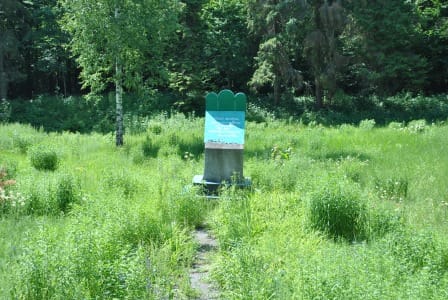
The car turned off the road between Belogorye and the village of Trostyanka and plunged into the forest thickets. We drove slowly, because the dirt road is not suitable for transport. Eventually, the trees parted, exposing the terrible place of execution of about five thousand of our brothers. The square plot is completely overgrown with grass and weeds, but the silhouettes of three memorial stones still rise above the greenery. Gray piles of dead Christmas trees, once planted along the perimeter of the plot, rose high. They have all outlived their usefulness, but they still stand, like silent sentinels. On the opposite side from the entrance, about ten sections of the metal fence are indeed missing; the remaining sections are in place, but the elements are disconnected at the places of the former quarrel, which still attracts seekers of "free" metal.
An asphalt path leads to the large memorial in the middle of the site. However, this becomes clear only when you open the overgrowth that covers it. The obelisk itself suffers from metal corrosion, cracks in the plaster, the inscriptions made with ordinary paint on a metal plate are still readable, but look very unreliable. Having bypassed the memorial sign from all sides, visitors do find the "cosmetic improvements" that were mentioned in the response letter! One of the corners of the structure is covered with mortar, apparently in the place where it was previously sprinkled.
As for the other two monuments, their fate is better. Mainly because they are made of rough granite, which is not afraid of corrosion. However, nature, which cannot destroy the monuments themselves yet, is actively developing the territories around them, hiding the stones in grass, bushes and trees.
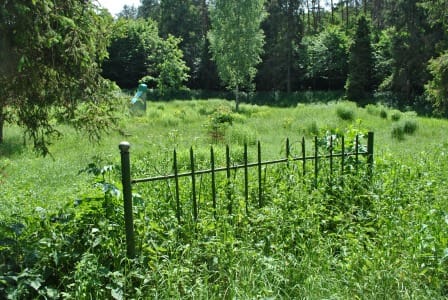
Schoolchildren were once assigned to clean up this area. Now, this option is unavailable, and even if it were available, it would be ineffective. The burial site needs major cleaning and landscaping, pruning of old trees, and repair of the fence.
During the visit to the grave, the deputy mayor of the city calls the guide to ask how the visit is going. After the call, Viktor Volodymyrovych jokingly says that no one here particularly wants to meet guests from the regional center, and the guests are not surprised.
It was with a heavy heart that we left the memorial. This is far from the worst burial place that exists or has existed in our region. There are no other mass graves within the boundaries of Belogorye, except for the soldier's grave. About five thousand Jews were buried in the tract near Trostyanka, and the current population of Belogorye fluctuates around four thousand people... Is it worth writing about the importance of this place in the forest thickets?
With the hope of the best, the managers switch from one topic to another. After all, there are still visits to clients ahead. This time, they should visit two women, both born in 1937. In the town itself - Larisa Alekseevna Kalenik, and Yevgenia Ivanivna Vasylyshyna in the neighboring village of Stepanivka. And if everything is clear with the first woman, then where to look for the second one is a rather complicated question. Viktor Volodymyrovych comes to the rescue again: using the close relationships of acquaintances inherent in the countryside and mobile communication, with the help of a familiar local "oligarch" they managed to clearly establish the location of the client in Stepanivka. At this, they said goodbye to the guide - it's nice when, even somewhere far away, you can meet sympathetic people who are not indifferent to someone else's grief.
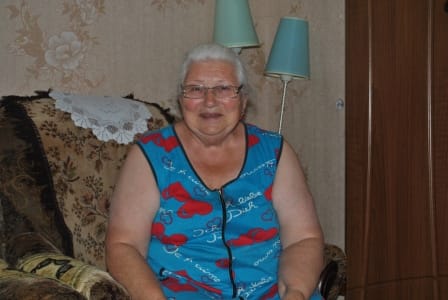
The meeting with Larisa Alekseevna takes place in a warm homely atmosphere. The woman recently changed her mobile number, but she completely forgot to inform the representatives of Hesed about it. Galina Atamanchuk found out the woman's needs, clarified her family ties. And although Larisa Alekseevna's children and grandchildren cannot be clients of the Fund based on income criteria, they are just able to attend community programs. However, the experiences and vicissitudes that the woman went through in childhood are evident. As a young prisoner of the ghetto, she saw with her own eyes what most people learned about from textbooks and books. The small food parcel that the managers brought with them will be useful to Larisa Alekseevna, but in the future she may receive a social card for medicines and food, which can already be used in Belogirya.
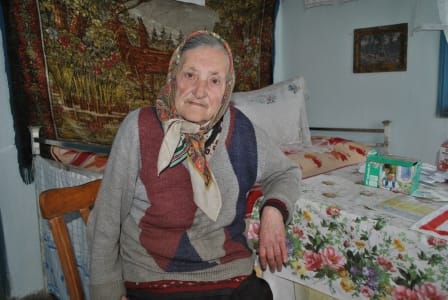
The road to Stepanivka turned out to be even more difficult, although the distance was not significant. Finding Yevgenia Ivanovna's house was not difficult: the first person they met in Stepanivka pointed out to the travelers the most cluttered house in the village. A single woman is not able to take care of the household, let alone clean the bushes or mow the grass. Very carefully, the guests made their way through the thickets to the porch, where the old woman met them.
If we draw a parallel between two women of 37 years of birth, then apart from the common age, it is difficult to find anything more. Having crossed the threshold of Evgenia Ivanovna's house, one can find oneself in the 19th century, both in cultural and everyday terms. It is difficult to stand on the floor, since in many places it has failed. The furniture, having not stood the test of time, has turned into a collection of scrap metal. The light is connected, but no one has noticed its special use; of the elements of telecommunications, the grandmother has only a mobile phone, which is used extremely rarely. Her only daughter lives in Riga and they have not seen each other for the last three years. The woman has no other relatives. The only other living soul in the house is a small cat that arrived in the spring.
The events of the Holocaust, which the woman also experienced, she recalls reluctantly and not without tears. Her family miraculously managed to survive, unlike other relatives who are buried right there in the forest under Trostyanka. She suffered a lot of evil from the occupiers. And later, she was often the object of mockery, according to her, for unfriendly villagers.
It will not be possible to solve Yevgenia Ivanovna's problems at once, even with the great desire of all the Fund's employees. That is why volunteers of the All-Ukrainian Volunteer Network "Community" have already become interested in her situation. A large-scale "operation" is currently being planned with the involvement of fifteen volunteers who, with good planning, are going to put Stepanivka in order in one day, cut down bushes, repair the floor, assemble furniture, check the electricity, and clean everything up. The organization is also concerned with the issues of social assistance for the old woman and the issuance of a card that can be used in Belogirya.
Khmelnytskyi Charitable Foundation "Hesed Besht" operates in 87 settlements of Khmelnytskyi and Ternopil regions. This means that as long as there is at least one client, even a historical or cultural monument, the "Region" program and the managers of the Foundation will take care of and look after it, search for it and support it. This is our noble humanitarian mission, which every employee proudly carries.
