
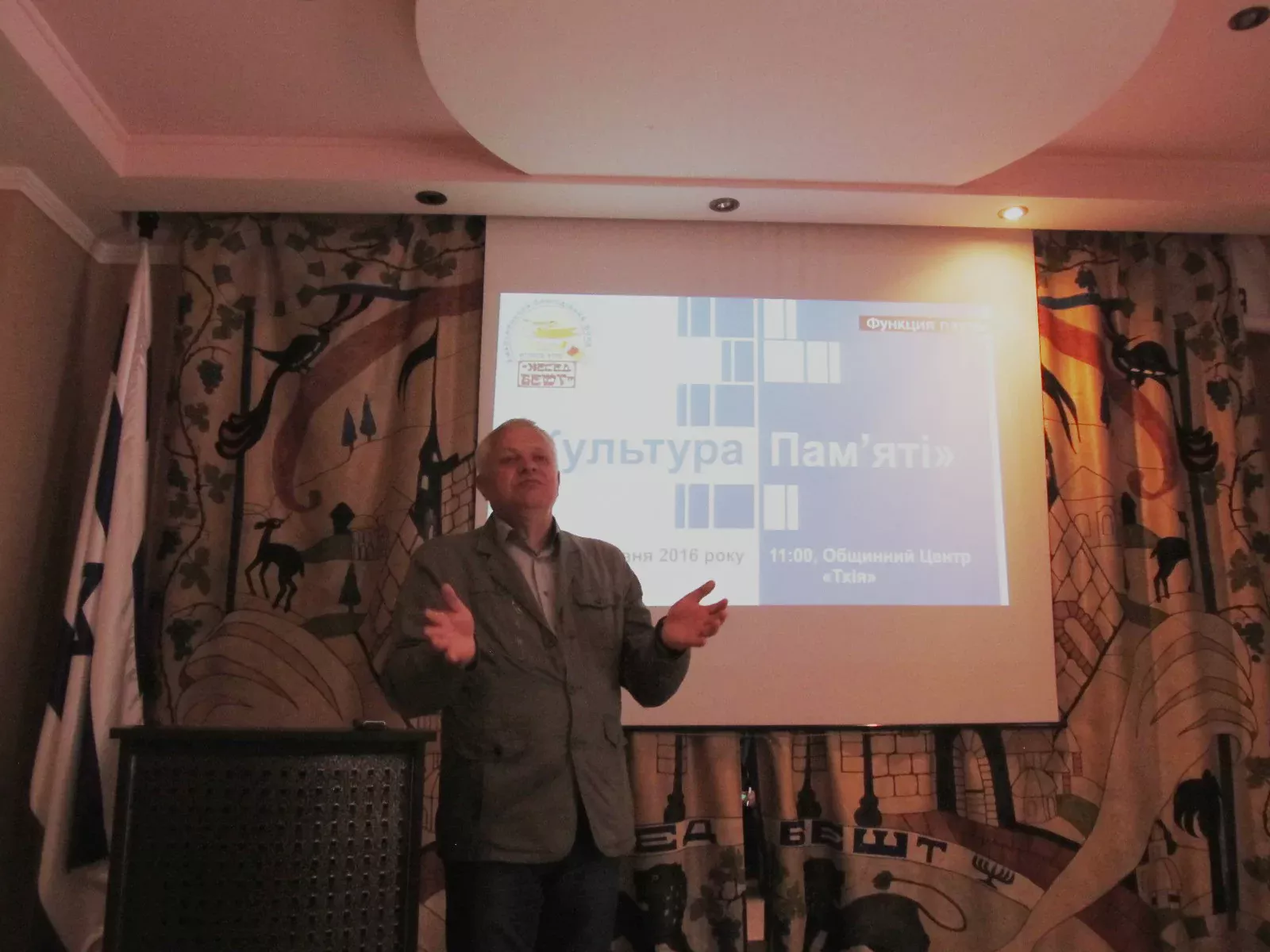
"Culture of Memory" is an event dedicated to the mechanisms and ways of preserving and transmitting memory to future generations. Here they talked not only about the Holocaust, although the main line was built on the examples of this catastrophe, but also about other actions directed against humanity that left a mark on the history of our region. After all, the Community Center "Thia" works for the development of the entire society and someone else's pain does not exist for us. And the formation of a unique culture while preserving memories and facts is a strategic task for all of us.
The prerequisite for holding the event was the participation of Khmelnytskyi journalists in an international educational project. Every year, the Khmelnytskyi Charitable Foundation "Hesed Besht" helps domestic media workers participate in a joint educational project Jewish Fund of Ukraine and Wannsee Conference House, Berlin, Federal Republic of Germany. In 2015, the editor of the newspaper "Shalom Aleichem" Vyacheslav Nagnybida came here from Khmelnytskyi region, and this year - the editor-in-chief of the newspaper of the Khmelnytskyi City Council "Proskuriv" Bohdan Telenko. The German approach to studying the events of the 20th century is somewhat different from what we are used to, so the journalists who participated in the project do not hide a certain degree of surprise. However, the methods that Germany has introduced in its educational and cultural spheres deserve not only attention, but also, in some places, outright admiration.
The organizers invited representatives of the authorities and public organizations to the event. Representatives of the Regional Department of Culture, the Department of Monument Protection, and soldiers of the Afghan conflict were present. Unfortunately, some officials responsible for the development of education and culture ignored the invitation. The key topic of today's event was the issue of preserving memory and the mechanisms of this process that are currently used in society, as well as adopting the positive experience of other countries.
Director of the Khmelnytskyi Charitable Foundation "Hesed Besht" Ihor Ratushny stressed that in modern society there is a big problem with the perception of the tragic events of the past. This is due to the low level of public culture of memory, insufficient coordination in the actions of both the authorities and public initiatives. Therefore, such meetings should activate multilateral dialogue and lead to an increase in the spiritual level of each of our contemporaries.
Bohdan Telenko shared his impressions and information from participating in the project. He highly appreciated the achievements of the Germans, but did not belittle the work of domestic cultural workers. German society is much more developed than ours both economically and culturally, so comparisons are inappropriate. However, the achievements of this European country can be very justified as a model. You can read more about everything you saw and felt in the columns of the newspaper "Proskuriv", where Bohdan Petrovych covers this topic quite fully.
Vyacheslav Nagnybida briefly reported on innovations in the use of mechanisms for disseminating information about the Holocaust, which were proposed by volunteers at the Hesed Besht Foundation. The event participants were the first to see the α-version of the Holocaust Museum tour computer program in action. The software is being developed by volunteers of the All-Ukrainian Volunteer Network “Community” and although the project is delayed in time, the volunteers are not giving up, improving their product. The volunteers want to replicate the finished version of the program for all educational and cultural institutions in the Khmelnytskyi region.
