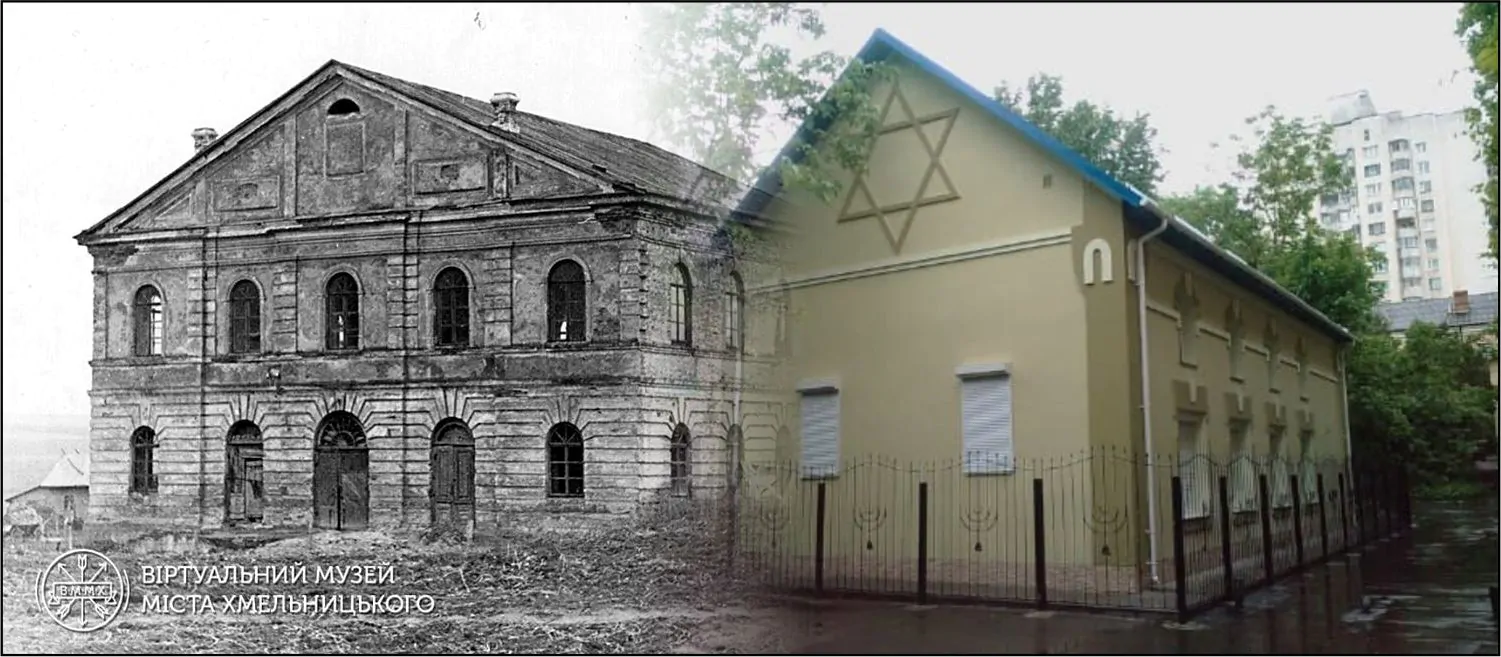
I would like to start from the end, that is, first recall the important news of recent years. Whenever researchers, local historians or journalists talk about Proskury, a prominent place in the history of the city is given to the Jewish community. Unfortunately, many of them were taken away by the horrors of the Holocaust and later by the Soviet "leveling". However, the history of the Jews did not end there. The first incomparable event of the 21st century in the history of the Jews of our region was the opening of a synagogue in Khmelnytsky! In 2009, the reconstructed Butchers' Synagogue (2 Pekarskyi Avenue) was put into operation. In fact, this event had a significant meaning: the Jewish community has recovered from the shocks of the past, it is moving forward and now the religious aspect is not in the background, but is being formulated as a clear need of the community. The reconstruction took place thanks to the work of the Khmelnytsky Charitable Foundation “Hesed Besht”, which has been restoring the Jewish way of life of the community since 1999, and the personal activity of its director Igor Ratushny, who set out to implement this difficult project. Financial support, of course, was provided by the American Jewish Joint Distribution Committee “Joint”. However, donations from members of the local community and the help of volunteers showed that the community strives to restore spirituality in the region. The opening of the newest synagogue marked a new stage in the life of the community, as after that, the “Thia” Community Center opened in 2010, and last year the Social Assistance Center began its work - together they are a triad of organizations that provide a reliable basis for the development of the Jewish community and effective communication with other nationalities, cultural integration and the instillation of tolerance. But this is what exists among us now. And it all started many hundreds of years ago…
The first mention of Jews in Ploskyrov appeared in 1627, and since the 18th century they have made up a significant part of the city's inhabitants. In 1765, when the population of our city was about a thousand inhabitants, the number of Jews reached 300 people. The census of 1864 registered 4190 Jews (out of 6930 townspeople), and in 1889 - 11482 (out of 17 thousand) - this is more than 60% of the total population of Proskurov. Approximately the same proportionsThey were preserved at the beginning of the 20th century: in 1907, out of 27,632 inhabitants of the city, 14,735 were Jews (54%), in the interwar period (1921-1941) up to 15,000 Jews lived in the city with a population of 30-40 thousand. The fascist occupation caused an irreparable loss to the Jewish population of Proskurov - in the 1950s, there were just over 6,000 Jews in the city.
Naturally, with such a large number of Jews in our city, there were a large number of synagogues and prayer houses. For example, in 1907, their total number was 18! Mostly they were small prayer houses (the so-called cloisters), among which the Great Choral Synagogue stood out. Built at the end of the 19th century in the neoclassical style, it majestically rose among the surrounding one-story buildings of the Jewish quarters.
Other synagogues were mostly small, because the main task for which a synagogue exists is reading the Torah (a synagogue is not a temple, but a kind of meeting house). And the greatest honor that a Jew receives is a call to read the Book of Books. When the community is large, the number of calls is limited, and you will wait a very long time for your turn. Therefore, those who could afford to buy a Torah scroll set up their own synagogue. This is how synagogues of artisans, water carriers, shoemakers, bakers appeared... In addition, you can't go to the synagogue on Saturday - you have to walk, so it's convenient when there is a synagogue in every block.
Numerous prayer houses were open for daily visits and often also served as premises for cheders (religious primary schools). In the Great Synagogue, however, Jews gathered only on Sabbaths and holidays or to listen to sermons by their own and visiting cantors — spiritual ministers (also called “khazans”), who skillfully led the service and, as a rule, had excellent vocal abilities.
The most important thing that every synagogue should have is the Aron Kodesh (Holy Ark), where the main shrine of Judaism is kept - the Torah scrolls. They are absolutely the same and identical in text in any community. These are all scrolls of the same Torah - the Pentateuch of Moses. The Torah scroll must be written according to tradition. That is, it is written by a special scribe - a soifer, only by hand on parchment with special ink. If it happens that the ink has crumbled or the scroll is somehow damaged and there is even one letter missing - it ceases to be kosher. It does not cease to be respected, but such a list can no longer be used for worship. The scrolls must be constantly checked, everything must be clearly visible and understandable. Old Torah scrolls can be restored. If they are very damaged, then you can not simply throw them away. They should be placed in a room where similar documents are stored or buried in a cemetery, like a human, to show respect.
On September 16, 2009, a reconstructed synagogue was reopened in Khmelnytskyi, which was built back in 1890, and it is unique – it is the only synagogue in Proskurov that has survived. It is located in Pekarsky Lane, near the vegetable market.
